> For the complete documentation index, see [llms.txt](https://script-and-theory.gitbook.io/order-armor-shipping-protection-docs/llms.txt). Markdown versions of documentation pages are available by appending `.md` to page URLs; this page is available as [Markdown](https://script-and-theory.gitbook.io/order-armor-shipping-protection-docs/settings.md).
# Settings
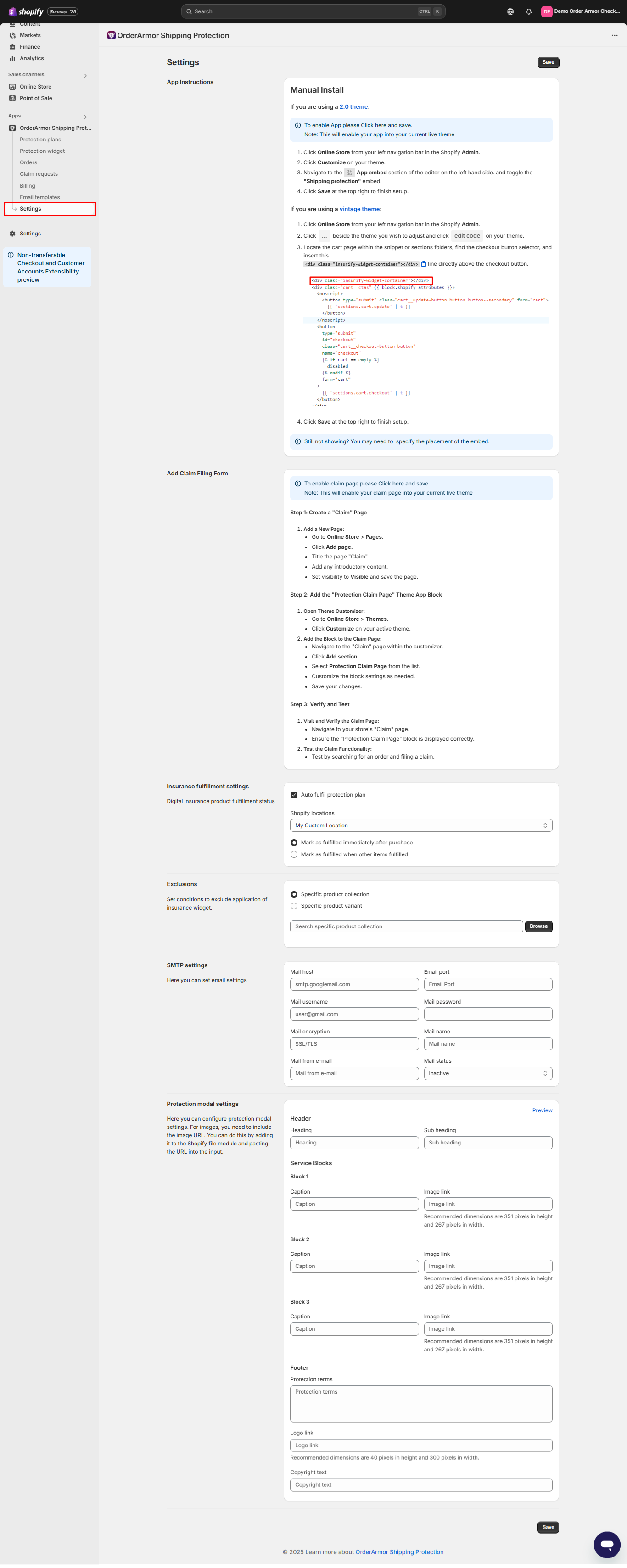
The **Settings** module in the OrderArmor Shipping Protection app allows you to configure core functionalities for integration, fulfillment, exclusions, email setup, and the protection modal. This section is essential for fine-tuning the app to align with your store’s operational and branding needs.
### App Instructions
This section offers setup guidance tailored to your Shopify theme type:
#### **For Shopify 2.0 Themes:**
1. Click **Click here** to enable the app embed extension.
2. Go to **Online Store > Customize** your theme.
3. Locate the **App Embed** section in the left-hand menu.
4. Enable **Shipping protection**.
5. Save your changes.
#### **For Vintage Themes:**
1. Go to **Online Store > Themes**.
2. Click **Actions > Edit code**.
3. Locate the cart page within the snippet or sections folders and paste the provided widget snippet **above the checkout button**.
* **``**
4. Save your changes.
If the widget still doesn’t show, follow the “specify the placement” link to troubleshoot.
### Insurance Fulfillment Settings
Configure when the digital insurance product is marked as fulfilled.
* **Auto-fulfill protection plan** toggle available.
* Choose from your Shopify **Locations**.
* Fulfillment timing:
* Immediately after purchase.
* When other items are fulfilled.
### Exclusions
Exclude the insurance widget from certain products:
* Choose between **Specific product collection** or **Specific product variant**.
* Use the **Browse** button to search and apply exclusions.
### SMTP Settings
Customize your outgoing email server settings:
| Field | Description |
| --------------- | ---------------------------------- |
| Mail host | SMTP server (e.g. smtp.gmail.com) |
| Mail username | Your email account username |
| Mail encryption | SSL/TLS support |
| Mail from email | Sender’s email address |
| Mail password | Email password or app-specific key |
| Mail port | SMTP port (typically 465/587) |
| Mail name | Sender name |
| Mail status | Toggle active/inactive |
### Protection Modal Settings
Customize the appearance of the protection widget popup/modal on your storefront.
**Available Settings:**
* **Header**: Heading and subheading text.
* **Service Blocks (3 available)**:
* Each block includes: Caption + Image URL.
* Recommended image size: **351x267 px**.
* **Footer**:
* **Protection terms** (legal text).
* **Logo link** for branding.
* Recommended logo size: **40 px high × 300 px wide**.
Click **Preview** to see real-time changes, and **Save** when finished.